Before picking a savings vehicle for your kid, it helps to get clear on what you're actually funding. Two common goals: retirement, decades away, or a first home purchase, maybe in their late twenties or thirties. The right account looks different depending on which one you're aiming at — and the good news is you don't have to choose just one.
For retirement: Trump Accounts are a genuinely great addition
Trump Accounts launched July 4, 2026, and for retirement savings they're hard to beat. Every eligible child born 2025–2028 gets a $1,000 seed contribution from the federal government — free money, on day one. From there, family and employers can add up to $5,000/year combined, and it grows completely tax-deferred as a diversified US stock index fund, just like a traditional IRA.
If the money stays invested until your kid is actually near retirement age, this is about as good a head start as a family can give someone: decades of tax-deferred compounding on top of a government-funded seed. It's a strong "and," not competing with anything else you're already doing — just add it to the mix.
For a first home: pair it with a UTMA
Here's the nuance worth knowing before you assume the Trump Account will cover everything: it's structurally a retirement account. Money can't come out before the child turns 18, and after that it converts into a standard traditional IRA — meaning a withdrawal at, say, age 30 to help buy a first home is treated as an early IRA distribution. That means ordinary income tax on the growth, plus a 10% penalty (only $10,000 of that is exempted under the first-time-homebuyer carve-out).
If a down payment for a first home is a goal you want to fund specifically, parents with the financial means to save in more than one vehicle may want to also open a UTMA custodial account alongside the Trump Account. A UTMA isn't a retirement account, so it doesn't carry any of that early-withdrawal baggage — it simply becomes your child's own asset once they reach adulthood, taxed at long-term capital gains rates when sold, with full flexibility on timing and use.
Seeing it side by side
To make this concrete: assume $5,000/year contributed from birth through age 17 (18 years, $90,000 total) into a diversified US stock index fund at 8% annual growth in each account type. Contributions stop at 18, and the balance keeps compounding untouched until age 30.
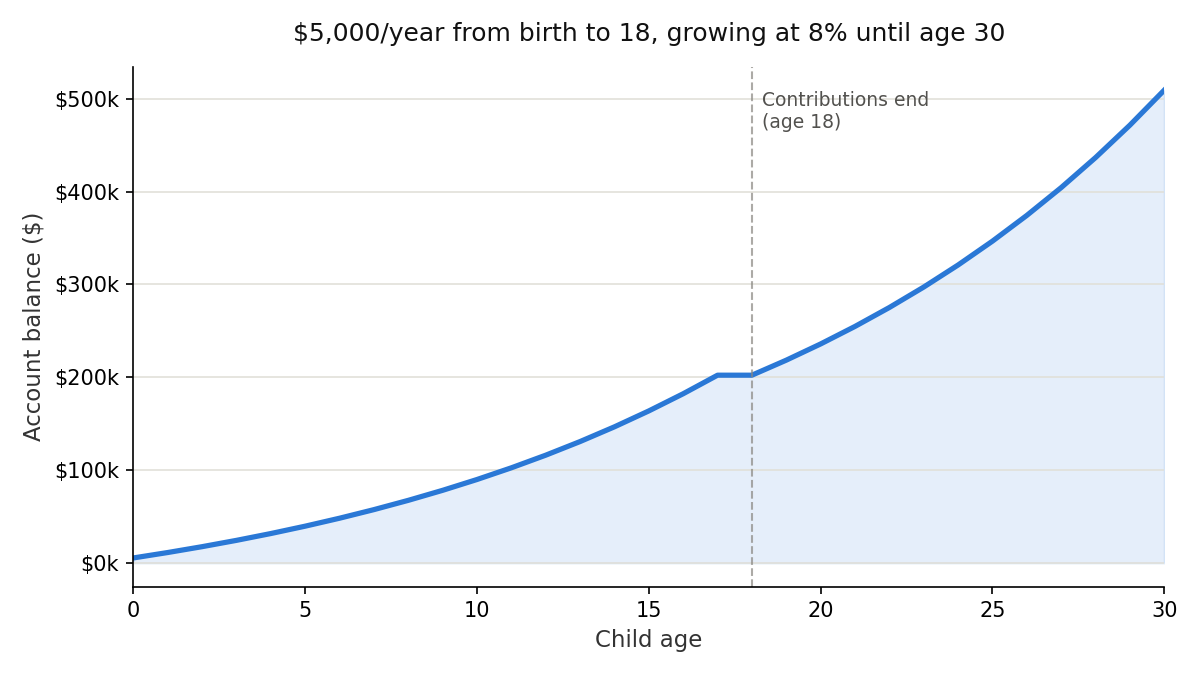
Both accounts reach the same $509,253 by age 30 under these assumptions — $90,000 of contributions plus $419,253 of growth. The accounts only start to differ once that money actually comes out.
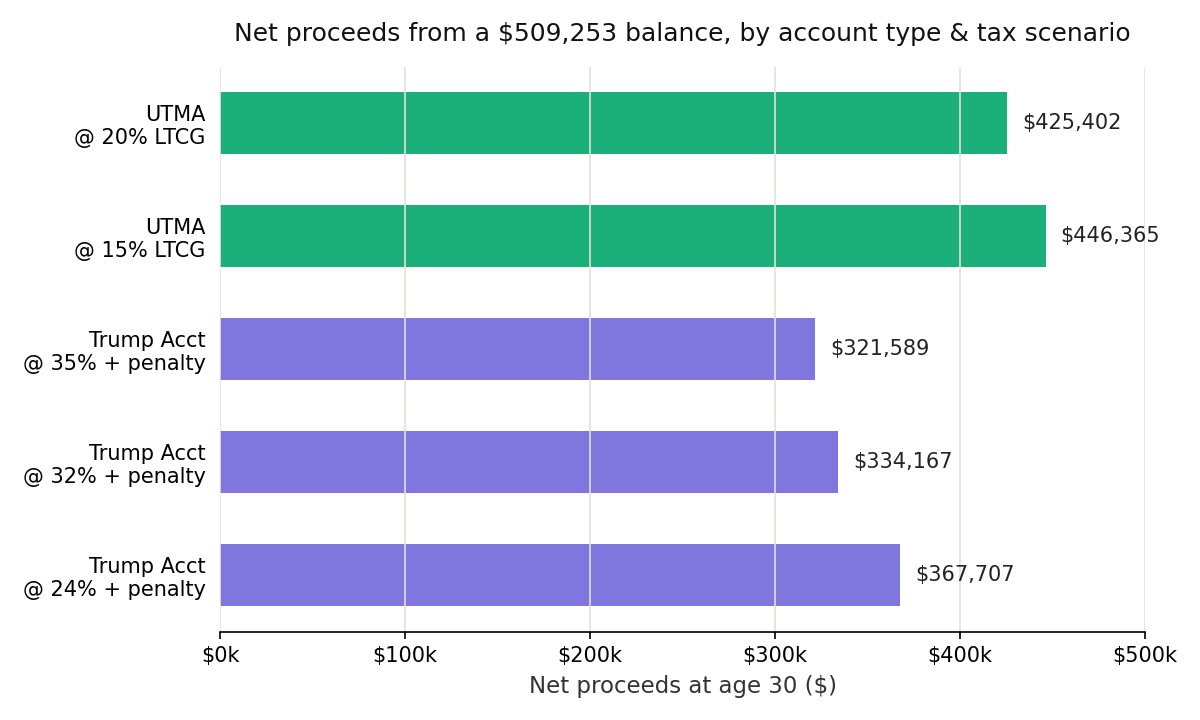
For a same-day withdrawal at 30, a UTMA nets your child noticeably more — because the gain is taxed once, at capital gains rates, with no early-withdrawal penalty. A Trump Account withdrawn at the same age carries an ordinary-income tax hit on the growth plus a 10% penalty on most of it. That's simply the cost of using a retirement wrapper for a non-retirement goal — not a flaw in the account, just a mismatch with the use case.
The takeaway
Think about what you're funding first, then pick the account (or accounts) that match:
- Saving toward retirement? A Trump Account is a strong, low-effort choice — especially with the free $1,000 seed money.
- Saving toward a first home or another pre-59½ goal? Consider layering in a UTMA alongside it, so your child has non-retirement assets with more flexibility when they become an adult.
- Have the means to do both? Many families will find the two accounts complement each other nicely — one for the long retirement runway, one for near-term life milestones like a first home.
Numbers above assume 8% annual growth, no state tax, and a full lump-sum withdrawal at age 30 — adjust for your own assumptions before treating this as a plan. This is general education, not personalized financial or tax advice; talk to a CPA about what's right for your family.
Planning your own home purchase? See how a down payment affects your long-term net worth.
Open calculator